Last updated on June 22nd, 2026 at 12:50 pm
Learning French is much bigger than memorising vocabulary lists or drilling grammar. To really move forward, you have to live the language: hear it, speak it and read it. Reading in French is one of the most enjoyable ways to do that, and one of the most effective.
Here is why reading works so well, a famous place every book lover should know, and how our reading club can help you practise with others.
The short version
- Reading teaches vocabulary in context, so words stick far longer than they do from a list.
- You pick up real idioms, grammar patterns and culture at the same time, even at an intermediate level.
- Start with something you will actually finish, and read for the overall meaning instead of every word.
- Reading with other people turns it into speaking practice, which is where most progress happens.
Why reading is one of the best ways to learn French
Plenty of learners avoid reading in French because they expect it to be too hard. Even at an intermediate level, it is one of the most powerful tools you have. Here is what it actually builds.
| What reading builds | Why it works |
|---|---|
| Vocabulary in context | Your brain ties a word to a scene, a character or a feeling, so it lasts longer than a word on a list. |
| Idioms you understand | You meet expressions like avoir le cafard (to feel blue) or donner sa langue au chat (to give up on a riddle) in real use, and can reuse them later. |
| Cultural insight | French books carry the country’s debates, humour, passions and history, so you sense how French speakers think and feel. |
| Motivation that lasts | A story that moves you makes you want to talk and write about it, which turns study into something personal. |
If you want feedback while you read, a native French teacher can turn a book you love into speaking and writing practice tailored to your level.
A cultural icon: the BnF, France’s national library
Talk about reading in France and one place comes to mind first: the Bibliothèque nationale de France (BnF). In Paris, it is one of the largest libraries in the world, with more than 40 million documents.
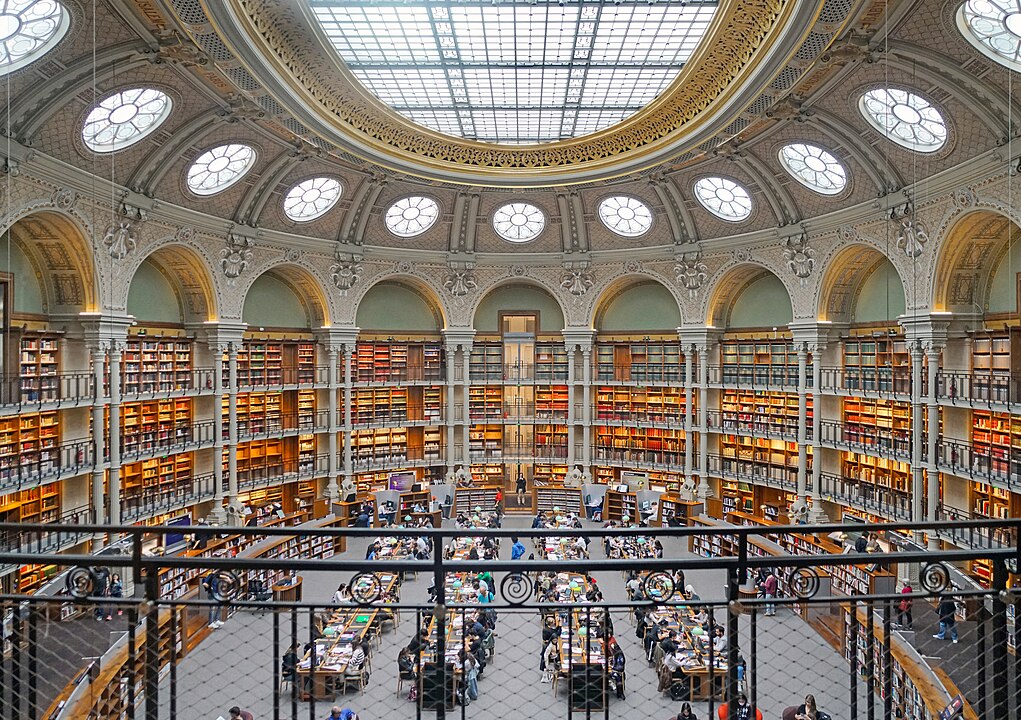
The modern François-Mitterrand site, with its four towers shaped like open books, is a striking landmark. The BnF also keeps historic treasures such as the recently restored Oval Room, now open to the public free of charge. Inside you will find Victor Hugo’s manuscripts, rare editions of Molière, centuries-old newspapers, maps and photographs.
For a learner, it is a good reminder that reading in French connects you to a living tradition, where every page invites you to go deeper.
Read with others: the Live French Book Club
Reading alone is rewarding. Reading with other people changes the experience, and that is why we created the Live French Book Club.
Each season we pick one accessible, engaging novel chosen for learners of French as a foreign language. We read it step by step and meet online to share impressions and practise speaking in a relaxed, supportive setting. Members tell us the best parts are:
- Speaking French without the pressure of a formal class.
- Hearing other readers’ views, which deepens how you understand the story.
- Tying the language to a fun, motivating community instead of a textbook.
Our next season starts soon. If you want to improve your French while enjoying a real French novel, you can join the reading club here.
Reading tip: Do not stop at every unknown word. Read for the overall meaning and only look one up if you are truly stuck or it keeps coming back. Guessing from context is part of the learning, and re-reading a page you already understand builds real fluency.
Your turn: a small reading challenge
Here is a simple habit that pays off. What is the last book you read, in French or any language? Write the title, and if you can, describe it in one sentence in French. Done every week, this stretches your vocabulary and sharpens your writing without feeling like study.
Reading in French is not only about words and grammar. It opens a door to culture, history and human connection. Whether you choose a French classic, a contemporary novel or a comic book, every page brings you closer to fluency. As Victor Hugo put it:
« Lire, c’est voyager ; voyager, c’est lire. »
To read is to travel; to travel is to read.
Frequently asked questions
Is reading in French a good way to learn the language?
Yes. Reading puts words in context, so your brain links them to a scene or a feeling and keeps them longer than a vocabulary list. It also builds your sense of idioms, grammar and culture at the same time, even at an intermediate level.
What should I read in French if I am not advanced yet?
Start with something you will actually finish: a short contemporary novel, a graphic novel or bande dessinée, a children’s book, or articles on a topic you love. Books written for French learners are a gentle entry point. The aim is steady reading, not difficulty.
How do I read in French without stopping at every word?
Read for the overall meaning first and only look up a word if you are truly stuck or it keeps appearing. Guessing from context is part of the process. Re-reading a page you already understand also builds fluency and confidence.
What is the Live French Book Club?
Each season we pick one accessible novel suited to French learners, read it step by step, and meet online to share impressions and practise speaking in a relaxed setting. It is a low-pressure way to read more and talk more.
Can I visit the BnF, and is it free?
The Bibliothèque nationale de France in Paris is open to the public, and spaces like the restored Oval Room are freely accessible. It holds more than 40 million documents, including Victor Hugo’s manuscripts and rare editions of Molière.
Live French · one-on-one Zoom lessons with native teachers since 2007 · 4.9/5 on Google
Perfectionnez votre français – cours d’essai gratuit! Inscrivez-vous ici